
The payments newsroom. Every morning.
Regulation, schemes, innovation, fraud, markets: what moved yesterday, analyzed and dated.
Top story · Schemes
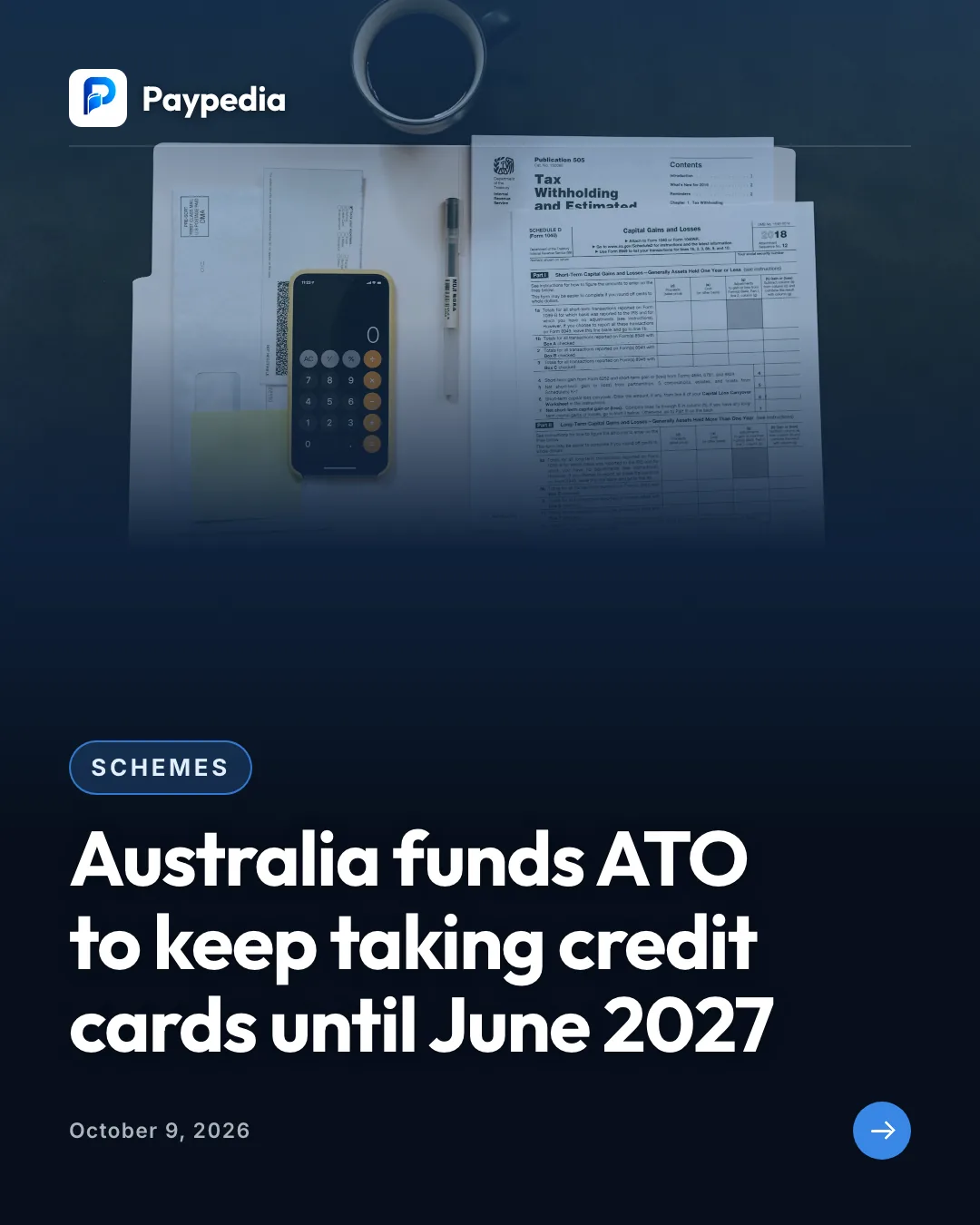
Australia funds ATO to keep taking credit cards until June 2027
Australia’s government will pay for its tax office to keep accepting credit cards until June 30, 2027. The ATO had planned to stop after November 30, saying the end of card surcharges left it almost A$200 million a year in fees to absorb.
Read the article ⏱ 5 min read
Where to start. Four ways in, depending on what you want to do.
I want to understandEncyclopediaHow it all works, explained and sourced: authorization, interchange, bank files.I want to learnCoursesOne-hour courses, each ending with a graded quiz.I want to fix a problemTools and disputesCheck an IBAN or a BIN, dispute a charge, gather the evidence.I want to stay informedNewsThe industry’s decisions and moves, dated and sourced.
The first encyclopedic MCP server for payments. IBANs, BINs, disputes, news, and training, in your assistant.
The payments MCP servers released so far expose a PSP’s API. This one exposes payments expertise: 17 tools covering reference databases, disputes, industry news, and training, running locally with no API key. The console below runs them for real.
Loading Paypedia tools…
Try:

Three very different audiences. The same refusal to cut corners.
🛍️
Consumers
A charge you don’t recognize, fees nobody explained, a payment abroad, a well-crafted scam: you leave with a clear plan of action.
- Dispute assistant: five scenarios, step by step
- “Consumer & everyday payments” course
- Payment pages to explore risk-free
🏪
Merchants & SMBs
A payment success rate that won’t budge, an unreadable PSP contract, a chargeback to fight: the exact levers, with numbers, and no sales pitch.
- Which transaction data gets payments approved
- PSP integrations compared
- Chargebacks: when the bank takes the money back, and how to respond
🏦
Payments professionals
ISO 8583, camt.053, TRA exemptions, VAMP, x402: formats, response codes, and rules, down to the detail you actually work with.
- Bank formats annotated line by line
- 100 courses, each with a graded quiz
- Daily news watch, sources cited
14 areas, 201 guides. From the first term to the bank file.
Behind every card payment, four parties talk to each other in a split second: this is the four-party model. Follow it all the way to the file the bank sends each evening, explained line by line, and compare it with yours. 151 glossary entries at your fingertips.
- What choosing CB, Visa, or Mastercard at checkout really costs
- Transaction data and its effect on approvals
- MT940, camt.053, CFONB120: real excerpts, explained
📨 MT940 statement · field :61:
Value date → amount → referenceannotated
🧭 Four-party model
Cardholder → Merchantpayment
Acquirer ↔ Issuerauthorization ~1 s
Interchange0.2% debit
100 one-hour courses. And a way to check it sank in.
Each course takes one hour, from Beginner to Advanced. Almost every chapter ends with a quick question, 277 in all, and every course ends with a graded quiz of 13 to 15 questions, with every answer explained. Your progress and best scores stay in your browser.
- 100 courses · 10 categories · 3 levels
- 277 quick questions, and a graded quiz at the end of every course
- Review flashcards for 44 of the 100 courses
🛡️ Fraud: detection & prevention
Chapter 3 · Scoring & ML✓ completed
Progress58%
🎯 Quick question
Which code signals a soft decline requiring 3DS?
A 3D globe, 48 countries analyzed. Every market has its own way to pay.
In the Netherlands, people pay with iDEAL, in Brazil with Pix, in India with UPI, and in Kenya with M-Pesa: cards are far from the norm everywhere. Spin the globe, open a country, and compare the shares of cards, wallets, and account-to-account payments. It’s the comparison to make before entering a market.
- Signature payment method, regulator, and e-commerce shares, country by country
- Seven analyses: Europe’s card schemes, Asia’s QR codes, Africa’s mobile money
- Where instant payments are already eating into cards
Payments by the numbers. Dated, sourced, projected to 2030.
19 indicators and 15 animated charts: mobile vs. desktop, wallets vs. cards, the rise of account-to-account payments, fraud, the decline of cash. Dated figures, open sources, and every chart also opens as a data table.
- Dated sources: Banque de France, ECB, GIE CB, Worldpay, FEVAD
- Card fraud: 0.053% in France, $33.4 billion worldwide
- 2030 projections: wallets, account-to-account, BNPL, cash
📈 Wallets vs. cards (global, e-commerce)
Wallet share (global e-com, 2030)≈ 62%
Pix transactions, 2025≈ 80B
Cash at the point of sale (global)↘ 15%
A card dispute, step by step. Deadlines, evidence, letters.
A charge you didn’t make? The assistant asks the questions your bank will ask, then walks you through the procedure for your case: Articles L. 133-18 to L. 133-24 of the French Monetary and Financial Code, the 13-month deadline you can’t let slip, the evidence to gather, and the letter to send.
- Customer side: fraud, package never arrived, hidden subscription, double charge
- Merchant side: fighting a chargeback, evidence by reason code
- Ready-to-send letter templates
🧭 What’s your situation?
Life-size checkout pages. Try it without reaching for your card.
Card checkout, wallets, brand selection on a co-badged card, a 3-D Secure challenge, bank transfer, pay-by-link: eight interactive mockups you can try risk-free. Click a field to see what it does, who requires it, and what it changes.
- 27 click-to-reveal explanations, field by field
- Choosing CB, Visa, or Mastercard on a co-badged card
- A simulated 3-D Secure challenge, screen by screen
Total49,90 €
CBVisa
Card number ?
4970 10•• •••• ••15
Frequently asked questions. Four straight answers.
Is Paypedia really free?
Yes, all of it: the Encyclopedia, Courses, quizzes, the Dispute assistant, and News. No account and no payment card required, which is a bit ironic for a site about payments. Your progress stays in your browser.
Who are the courses for?
100 courses, sorted by level from Beginner to Advanced and by category: a consumer can learn to dispute a charge while a professional brushes up on TRA exemptions or the camt.053 format. Each course takes one hour and ends with a graded quiz.
Where do the figures and news come from?
Every figure is dated and linked to its source: Banque de France/OSMP, GIE Cartes Bancaires, ECB, Worldpay, FEVAD. An article comes out every morning, drawn from our monitoring of payments news, under a strict rule: at least three primary sources cited, and no figure without its source.
What are “agentic payments”?
Payments made by an AI agent on behalf of a person or a machine. The central question is proving that the agent was allowed to pay. The AP2, ACP, and x402 protocols each answer it in their own way, alongside Visa, Mastercard, and Cloudflare. A whole area of the Encyclopedia and two courses cover the topic.
One hour, and the jargon falls away. The Encyclopedia takes it from there.
The “Payment fundamentals” course sets out the vocabulary and the path of a transaction: who authorizes, who collects, who pays what, and why an authorization is not yet a charge. Seven chapters, one hour, and a quiz at the end. The Encyclopedia then takes over, all the way to bank reconciliation and agentic payments.